TheAnthroGeek

The Study of Humanity’s Geekiest Blog

  • I’m happy to be living in Fresno, CA, USA, one of the major bread baskets of the US and a place that is much warmer than the last few places I’ve lived.  But the challenges faced in terms of educating members of this community are high.  I have been working to educate my students as to the value of inductive approaches to solving problems and to the usefullness of Design Anthropology and other types of participatory design that are highly regarded in industry.  But I was surprised to find that members of Fresno’s leadership is also missing the point regarding the value of these methods.

    Note the following exchange from a local listserve:

    Date: Mon, 10 Nov 2008 08:30:50 -0800
    From: “Henry D. Delcore” <hdelcore@csufresno.edu>
    Subject: Re: [MindHub] Your tax dollars at work?
    To: Mindhub <mindhub-list@list.mindhub.org>
    Message-ID: <003e01c94351$b1f1b6f0$15d524d0$@edu>

    I don’t know enough to vouch for the value of the specific exercise that the
    city’s managers went through, the quality of its delivery, or whether it’s
    costs were reasonable.  But, there is nothing outrageous about using toys
    for this kind of activity.  Let me explain.

    What Councilman Duncan described sounds a lot like the participatory design
    activities that my colleagues and I at the Institute for Public Anthropology
    at Fresno State use to probe market opportunities for clients.  The basic
    idea behind participatory design is that we are all designers, and that
    engaging users in the design process results in better products and
    services, and hence profitability.

    Why use toys and other playful methods to try to get at what people want or
    think about topic?  The idea, well founded in social and cognitive sciences,
    is that people can’t readily talk explicitly about many aspects of their
    needs, desires and experiences.  The talk they do produce tends to be not so
    creative.  The more creative, yet submerged aspects of their beliefs and
    ideas can be drawn out with the right methods, especially methods that get
    away from merely writing or speaking about some topic.  Therefore, design
    firms and in-house product design departments are using Legos and other
    tools to get to the creative stuff that we all have inside of us, draw it
    out, and incorporate the insights into innovative products and services.

    You may have seen the Fresno Scrapers announcements I sent out to this list.
    This is the kind of method we use at Scrapers meetings, and for non- and
    for-profit clients here in the Valley.  These are the same methods used in
    the most innovative sectors of the economy, like the technology industry.

    Again, I don’t know enough about the specific activity the city’s people
    went through, but using a toy like Legos is well-founded.

    Finally, Lego itself has changed much, no longer “just” a toy, but a serious
    educational tool and aid for innovation:
    http://en.wikipedia.org/wiki/Lego_Mindstorms
    http://mindstorms.lego.com/eng/Ontario_dest/Default.aspx

    Sincerely,
    Hank Delcore

    **********************************
    Henry D. Delcore, Ph.D.
    Department of Anthropology
    California State University, Fresno
    5245 N. Backer Ave.
    Fresno, CA? 93740
    dept office:? (559) 278-3002
    direct line:? (559) 278-2784
    fax:? (559) 278-7234
    hdelcore@csufresno.edu

    —–Original Message—–
    From: mindhub-list-bounces@list.mindhub.org
    [mailto:mindhub-list-bounces@list.mindhub.org] On Behalf Of Jerry Duncan
    Sent: Sunday, November 09, 2008 10:26 AM
    To: mindhub-list@list.mindhub.org
    Subject: [MindHub] Your tax dollars at work?

    Apparently on Friday, November 7th, all members of the City’s upper
    management were taken off-site to go through a day long exercise of building
    a united vision of the future of Fresno using Legos. Yes, the popular toy.

    My understanding is THOUSANDS of dollars of Legos were purchased from
    locations all over the valley and the intent was to build a Lego version of
    Fresno that will actually be displayed in City Hall.

    Jerry

  • I just read a great posting on SavageMinds by Christopher Kelty about the age of Free software and free services that we are living. This is a glorious golden age of free software and as Kelty states, it has absolutely helped some of us innovate. I have worked on robotics projects with poor rural middle school students and have helped undergraduate students and non-for-profits start a number of websites and blogs.

    But, I fear, it will not last. I fear it will be just like the last golden age where the cataclysmic bursting of the dot-com bubble ushered in the dark ages of the Microsoft empire. I am enjoying it while all these free apps are here but Google will have to become the ‘grumpy old troll under the bridge’ eventually. It comes with the territory of being a behemoth. This should not come as a surprise to anyone – Ibn Khaldun (one of the world’s first ethnographers!) described these cycles in the Muqaddimah in the 14 century. Microsoft was cool in the beginning but everybody loves to hate them now.

    But there are some signs of hope in the following developments that even Ibn Khaldun would have trouble explaining:

    Apple made SproutCore open source.

    Google made Android open source.

    The real tragedy will come when the U.S. finally crosses the Digital sub-Divide (i.e., universal high speed internet access) and most of these fun, cool, free applications will have been swallowed up and licenced by the big guys.

  • NPR’s recent story entitled Looking at the Future of E-Politics points out the need for nationwide broadband access in the United States. Listen closely to the story and they sometimes conflate the “need for Internet access” with the “need for high speed Internet access”.

    What I’m referring to as “the digital sub-divide” is the conflation of a current {2008} desire for all Americans to be able to have broadband access and an older concern of a few years ago about any sort of internet access being yet another class marker of the haves vs. have nots in the United States.

    Wikipedia states that “the term digital divide refers to the gap between those people with effective access to digital and information technology and those without access to it”. As recently as five years ago, there was a real class divide between Americans who surfed the net and those who didn’t. That is no longer the case, particularly in light of the fact that some mobile phones are faster than some internet connections. The organization internetforeveryone.org clearly understands this as illustrated in their first objective: “Every home and business in American must have high-speed internet access”. With the advent of “cloud computing” high speed access is quickly becoming an important determining factor in connectivity in the United States. Robin Bloor’s recent post entitled, “Everything as a service: The the growth of cloud computing” clearly illustrates this change.

    The US is the fourth most wired place on the planet. There are rural pockets that have no access to broadband but this should not be confused with what is now being referred to as “The Global Digital Divide” (see the map below that I found on Wikipedia) where entire nations lag behind others in terms of any level of connectivity. Gary Chapman’s work is more illustrative of this “global digital divide”.

    And this is more than just a rant! I recently participated in a rather large project (several hundred thousands of dollars) with a large service provider that conflated these very issues as NPR has done. For the service provider, it maybe some sort of strategic oversight; for NPR, its just bad reporting.

    The Global Digital Divide
    In summation: YES, it would be great and more democratic if all US citizens had broadband access, but NO, there is no longer a digital divide in the US when you can take an Iphone and watch YouTube clips most anywhere.
  • Whatever you can do, or dream you can, begin it. Boldness has genius, power, and magic in it.

    -Goethe

    In celebration of the anniversary of Brown v. Board of Education

    grateful for gratefulness

  • The current debate about the role of technology in the classroom is a challenging one to follow.  Initially, computers were thought of as a panacea that would improve scores. Then, a backlash came when kids were found to be “screwing around”* with those very devices rather than “learning”.  Now, I’m seeing a third wave where some people are realizing that not all “screwing around” is actually “screwing around”.  There are many skunksworks that clearly illustrate that some forms of organized disobedience can sometimes be very productive and profitable.  But one does not need a major corporation to innovate.  Creativity can be found in “the street” as well.  William Gibson’s famous dictum “the street finds its own uses for things” (“Burning Chrome“, 1981) points to the power of human ingenuity in adverse disempowered contexts like poverty or “American adolescence”.  Lévi-Strauss’ use of the term “bricolage” is a more classical version of this observation.

    What is “bricolage” you might as? Wikipedia’s correct when they say bricolage is “borrowed from the French verb ‘bricoler’ – equivalent to the English “do-it-yourself”, the core meaning in French being, however, “fiddle, tinker” and, by extension, “make creative and resourceful use of whatever materials are at hand (regardless of their original purpose)”. 

    My research puts me contact with adolescents (middle school students) who “screw around” with robotics and “pre-engineers” (college students) who “fiddle, tinker and create” technology. 

    What would happen if our analysis started considering those adolescent kids ‘technological innovators’?  The kids’ transformation from “trouble makers” to “intellectual bricolers” would improve our knowledge base by realizing that some very creative things come from the minds of the disempowered.  This would also improve the educational preparation of students to the degree that they would potentially realize that their “play” is actually “work” in another context.


    *[Use of the term “screw around” originates from Garfinkel, “Consider that once you get into line persons will not therein question that you have rightfully gotten into line unless you start screwing around. Then you get instructed” (2002: 257).  Follow this link to better understand how Garfinkel’s  “screwing around” links to this discussion via a discussion of Varenne’s “productive ignorance”.]

  • Trifles make perfection, and perfection is no trifle.

    -Michelangelo

    Grateful to Gratefulness.org

  • “Anthropology will survive in a changing world by allowing itself to perish in order to be born again under a new guise.”Claude Lévi-Strauss, quoted in Lewis (1973: 586).

    Thanks to the very rad openanthropology project for the quote.

  • Let me start my tirade by pointing out that I’ve got nothing against the BBC. When I lived in Mali then Egypt, the BBC was all I listened to. I currently record their nightly TV broadcast to keep up on the world news. But look at the wording they chose to publicize this very important Anthropological finding. To say the least, it was a rather “crappy” way to describe recent findings that suggest humans were in the New World a couple thousand years longer than Anthropologists had originally assumed.

    This rather cheap shot reminds me of the fat kid in grade school – even the most dimwitted could find a way to poke fun at him.  Well, I won’t stand idly by and let this one pass, Anthropology deserves better!!

    Defiantly Yours,

    ex-fat kid

  • Those who dwell, as scientists or laymen, among the beauties and mysteries of the earth are never alone or weary of life. – Rachel Carson

    grateful to grateful.org

  • EthnoPraxis in Action

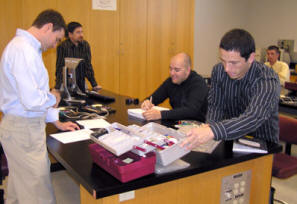
    Not only was the Ethnography in Industry class designed by Hank Delcore the first Tri-College initiative on the Fresno State campus (combing students and faculty from the Colleges of Social Science, Business and Engineering) but the news story about this initiative was the most read (clicked) news article on fresnostatenews.com

    Link to article: http://www.fresnostatenews.com/2008/03/TriCollege.htm

    Link to more background on the Institute of Public Anthropology web site.